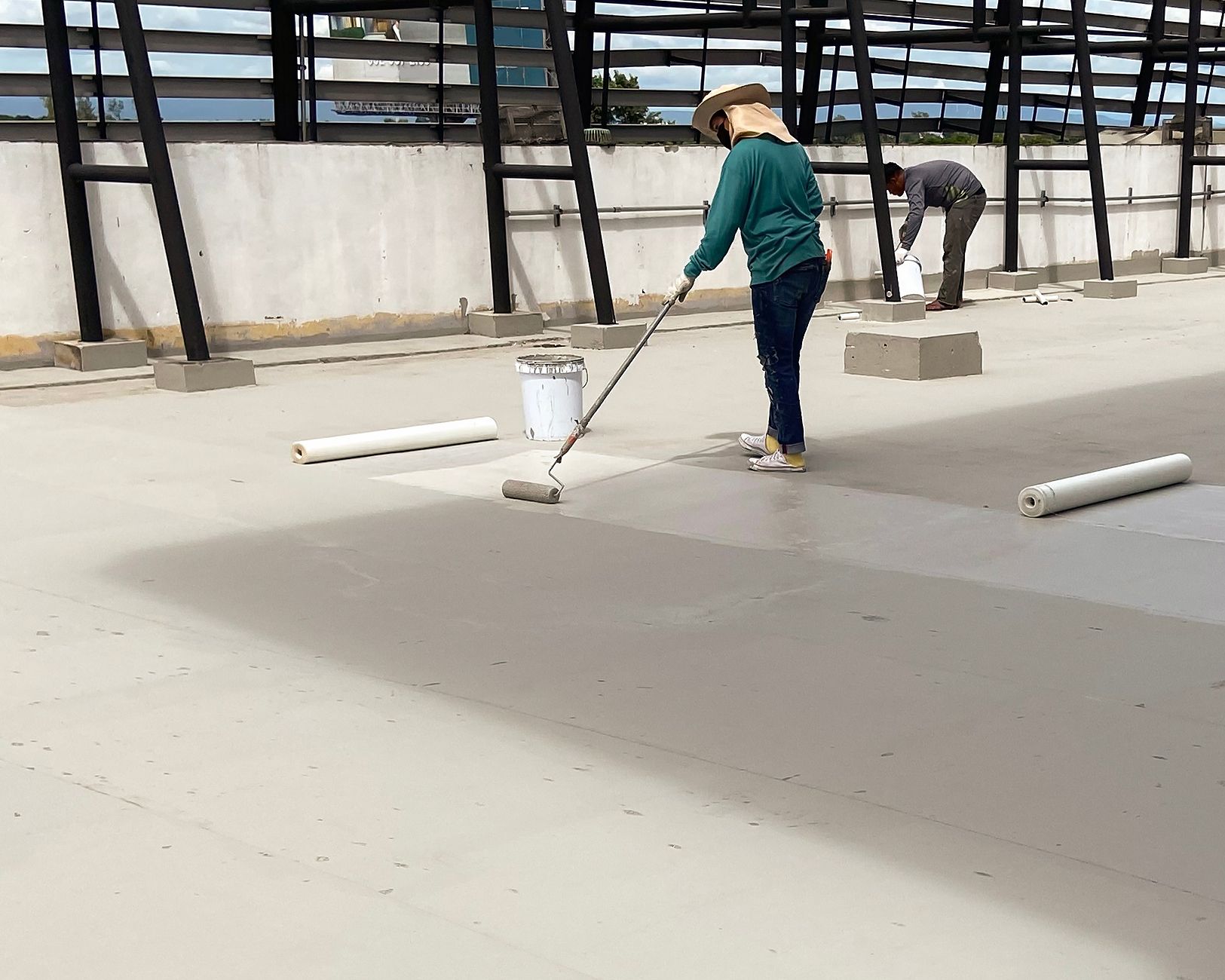
A roof coating in Mesa AZ can add years to a sound flat roof and waste money on a failing one. Here is how to tell which roof you have before you spend.
A coating is not a roof, it is a layer that protects one, and the distance between those two ideas is where most of the money on this kind of project gets wasted.
Applied over a sound flat roof, an elastomeric coating in the Valley can add close to a decade of service while cutting heat gain noticeably, but applied over a roof that has already failed underneath, it hides the problem for roughly one season before the leaks come back.
What The Product Actually Does
Elastomeric coatings go on as a thick liquid and cure into a flexible, seamless membrane across the entire surface, and that flexibility is the whole reason they work here. Valley roofs expand and contract every day of the year, moving through a sixty degree swing between three in the afternoon and sunrise the next morning, and rigid materials eventually crack under that cycle while a coating stretches along with it.
Reflectivity is the second function, since most coatings go down white or light gray and bounce back a substantial share of the solar energy that would otherwise soak into the roof and radiate into the space below.
That same reflectivity is why no coating is permanent, because dirt accumulates and the surface chalks and thins under constant ultraviolet exposure until the layer needs renewing.
The Roofs Coatings Belong On
Foam roofs need one by design, since spray foam offers excellent waterproofing and insulation with almost no ultraviolet resistance, which leaves the coating as the only thing standing between the foam and the sun. Recoating a foam roof on schedule is maintenance rather than repair, and it is what allows that system to keep performing more or less indefinitely.
Modified bitumen and built up roofs take coatings well too, provided the substrate underneath is still intact, and a cap sheet that has weathered but stayed watertight makes a strong candidate.
Metal is another common application, particularly on older panel systems where fasteners and seams have started to weep, because a coating bridges those small openings without a full tear off. Commercial buildings across Mesa lean on coatings heavily for exactly that reason, since recoating happens with the business open and the roof still in service, which is never true of a replacement.
The Roofs They Do Not Belong On
Wet insulation is the clearest disqualifier, because sealing the top of a roof that already has water in its layers traps that moisture inside, and the decking underneath keeps deteriorating where nobody can see it.
Widespread substrate failure rules it out as well, since coating a roof with open seams, deteriorated felt and multiple soft spots amounts to stretching a flexible skin over a structural problem.
Extensive ponding needs correcting before anything gets applied, as standing water sitting for days breaks down most coatings faster than the manufacturer ever projected, which makes the drainage issue the actual repair. A roof that has already been coated several times is usually finished as a candidate too, because those layers accumulate weight and eventually stop bonding properly to what sits beneath them.
The Assessment That Settles It
The question is never whether a coating would help, it is whether the roof underneath is sound enough to be worth protecting, and that gets answered through a moisture survey and a physical inspection rather than a look from the parking lot.
We check for saturated insulation, probe the substrate for soft areas and examine every seam, penetration and drain on the roof, and where something looks questionable we sometimes take a small core out of the roof to see exactly what the layers look like. Learning that a section is wet from a two inch cut is far cheaper than learning it from a coating that fails in eighteen months.
Photographs come out of every one of those inspections, so you can see the wet section or the failed seam yourself before anyone at Blackline Roofing and Contracting tells you what the roof needs.
How The Work Goes
Preparation accounts for most of the job and most of the reason coatings fail early, because the roof has to be cleaned thoroughly and a coating applied over dust, chalk or biological growth bonds to the debris rather than to the roof.
Repairs happen before anything else goes down, with open seams sealed, damaged sections patched and flashing addressed while the surface is still accessible and there is nothing covering it.
Primer follows where the substrate calls for it, then the coating itself goes on in multiple passes, since manufacturers specify a total cured thickness and hitting that number is what determines whether you get the warrantied service life or half of it. Curing needs dry weather and moderate temperatures, which is one more reason coating work in the Valley belongs between October and May rather than in the middle of monsoon season.
What It Buys You
The clearest return is time, because a sound flat roof that would have needed replacing in three years can often run another eight or ten with a properly applied coating.
Reflectivity shows up in cooling costs, though how much depends heavily on the building, since a low slope commercial roof over conditioned space sees a far bigger difference than a small patio section on a house.
There is a disruption argument as well that matters more than it sounds, because coating involves no tear off, no dumpsters and no exposed decking, so the space underneath stays fully usable throughout. What it does not buy is a reset, since a coated roof remains the same roof with the same age and history, extended rather than replaced.
When To Stop Coating And Replace
Every roof eventually reaches the point where another coating is money spent on a system that has run out, and recurring leaks in different areas, decking that flexes underfoot and insulation reading wet across large sections all point in that direction.
The honest version of that conversation is the one worth having, because a contractor who recommends coating a roof with saturated insulation is selling you two years and you will pay for the replacement anyway.
We handle repairs, coatings and replacements, and none of those is the answer we start from, since the roof itself determines which conversation makes sense.
Find Out Which One You Need
If your flat roof is aging, leaking occasionally or simply overdue for attention, a coating may be exactly right, and it may also be the wrong spend entirely, which is worth knowing before a crew shows up with product.
We work on flat and low slope roofs across Mesa, the East Valley and the greater Phoenix area. Contact us for an inspection and we will document what the roof is doing and tell you plainly whether a coating makes sense for it.