
The call usually comes in October, from a homeowner who watched storms roll over the neighborhood all summer, saw nothing wrong afterward, and then found a stain spreading across a bedroom ceiling during the first slow rain of fall.
Nothing about that sequence surprises us anymore. Most of the monsoon roof damage repair that Blackline Roofing and Contracting handles is work on damage that happened months earlier and stayed quiet until the weather changed enough to reveal it.
The Storm And The Leak Are Months Apart
A monsoon downburst hits hard and moves on within the hour, throwing water at the roof sideways for twenty minutes before the sky clears again. Roofs generally handle that better than you would expect, because the damage a storm causes is usually structural rather than immediate, meaning something shifts or tears without letting water through right away.
Then October arrives with a rain that falls straight down for six hours, and water that has nowhere to run finds the opening that has been waiting since July. That delay is the reason a leak so often feels like it came out of nowhere, when in reality the roof has been compromised since the middle of summer.
Wind Works On The Edges
Monsoon gusts rarely tear a roof off in any dramatic sense, and instead they pry at the perimeter and at every place where two materials meet. On a tile roof that means lifting a tile just enough to break its seating and slide it out of line, and because the tile usually settles back down looking almost normal, the tear it left in the felt underneath goes unnoticed from the ground.
Shingles fail through their adhesive instead of their position. Every course is bonded to the one below it by a seal strip, and once a gust breaks that bond the shingle flexes with every wind that follows, working its own nails loose a little more each time until water has a path.
Ridge caps, rake edges, drip edge and eaves take the worst of it in both cases, since those are the points where wind can get underneath the roof system rather than simply blowing across it.
Dust Does More Damage Than People Expect
Valley storms carry an enormous amount of loose material, and sand, gravel, palm fronds and whatever the wind picked up two streets over all end up on your roof. That debris packs into valleys and collects around vents and equipment curbs, where it holds moisture against the roof surface long after the sun comes back out and blocks the channels tile roofs depend on to move water off.
On flat and low slope sections the debris heads straight for the drains, and a single blocked scupper turns a roof designed to shed water in minutes into a shallow pool that sits for days. Clearing that material after a storm is one of the more useful things a homeowner can do, and it costs nothing but an afternoon.
What You Can Check From The Ground
Stand back from the house and look along the tile courses, which should run in straight and even lines, so a dark gap or a tile sitting slightly out of rank is worth noting even if nothing appears broken. On a shingle roof you are looking for bare patches, corners that have curled upward, and shingles that sit at a different angle than the ones around them.
The gutters tell you a good deal as well. A heavy accumulation of granules means the shingle surface is wearing through, while dark papery flakes point to deteriorated underlayment coming apart somewhere above, and fascia or gutters pulled away from the house confirm that the wind that day had real force behind it.
Why We Start On The Roof Instead Of The Driveway
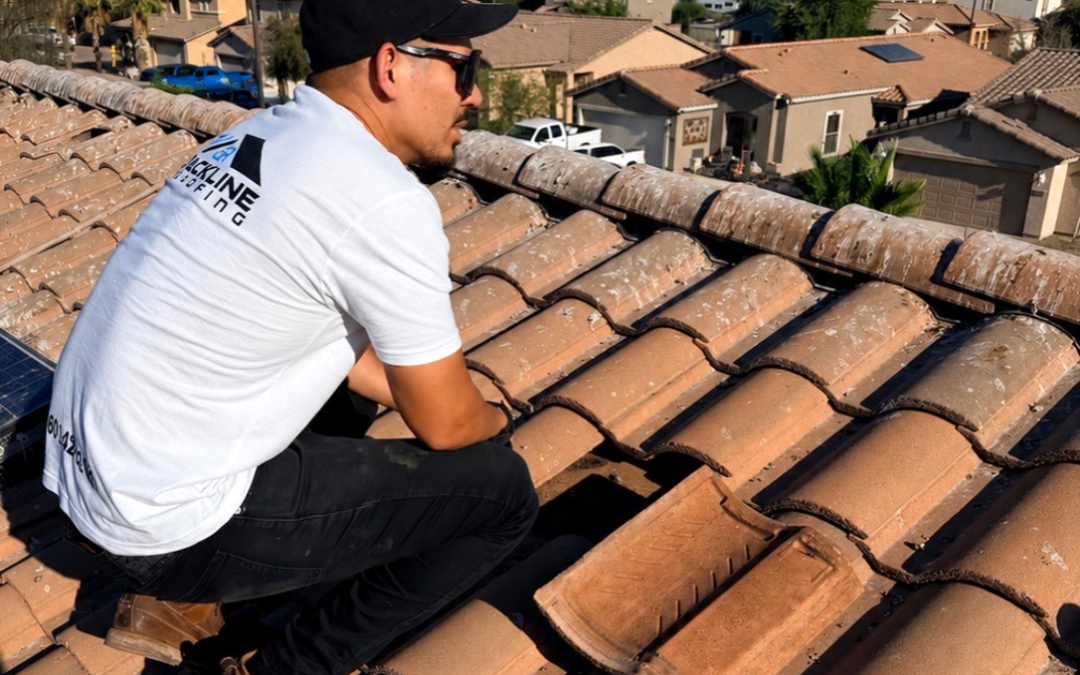
Almost everything worth finding after a storm is invisible from below, which is why our inspections begin on the roof itself and why we photograph the condition rather than describe it.
Torn Underlayment
Underlayment is the waterproof membrane beneath your tile or shingles, and it is the layer actually keeping water out of the house rather than the one you can see. When a tile lifts in a gust and drops back into place, the tear it leaves in the felt below stays completely hidden, and since Arizona heat has already been working on that material for years, a fresh tear in aging underlayment often decides whether the roof makes it through winter.
Flashing That Lost Its Seal
Flashing seals every point where the roof surface is interrupted, including chimneys, walls, skylights, vents and pipe penetrations, and those joints are where the majority of Valley leaks begin. Wind flexes the metal enough to crack the sealant behind it, so the flashing can look entirely intact while the seal it depends on has already opened up.
Standing Water On Flat Sections
Plenty of Mesa homes carry a flat section over a patio, addition or garage, and once storm debris blocks the drainage, water sits in an area built to clear within hours. Ponding water eventually finds every seam and fastener beneath it, and it adds weight the roof was never designed to hold for days at a time.
File While The Trail Is Still Warm
Wind damage is often covered by homeowners insurance, and coverage itself is rarely the sticking point. Timing and documentation are, because carriers want damage connected to a specific weather event, and the longer the gap between the storm and the claim, the harder that connection becomes to demonstrate.
Dated photographs taken from the roof carry far more weight than any written description, which is why we document everything we find and can walk you through the process if you need support with a claim. Some damage will not qualify no matter how the timing lines up, and hearing that up front is better than hearing it after a denial.
What The Repairs Usually Involve
Most post storm work stays contained, with broken and slipped tiles replaced and reseated, torn sections of underlayment patched, and flashing reset with new sealant. The larger jobs almost always come from damage that went unaddressed, because once decking has gone wet it has to be cut out and replaced, and at that point a roof project starts reaching into the house.
Our storm restoration work covers both ends of that range, though the version that starts with a call in October is nearly always the smaller and less expensive one.
Have Someone Walk It Before Winter
If storms passed over your street this summer, the absence of a leak does not mean the absence of damage, and more often it just means the rain has not been slow enough yet to expose what is up there.
We work on tile and shingle roofs throughout Mesa and the East Valley, and every inspection ends with photographs you can look at yourself. Get in touch and we will show you exactly what this season left behind.